The long sloping flanks of the extinct andesite cone of Mt. Pureora dominate the landscape west of Lake
Taupo. The cone has given its name to a forest park which contains some of the best podocarp forest and
most abundant bird life in the North Island. There are fine examples of miro, matai, rimu and totara
over 40m in height. It is also one of the last habitats of the kokako. One of the park’s most noteworthy
features is the particularly well-preserved buried forest underlying the pumice deposited by the Taupo
eruption of 200AD. This pack-carrying weekend proved to be a great way to gain fitness for the forthcoming
summer tramps! It was certainly not a soft option, providing a good physical workout for the participants.
The weather was variable. Some impressive examples of rimu and totara were passed, and kereru, kaka,
and grey warblers were encountered.
Friday
After travelling to Taupo, we stayed
overnight at Taupo Baptist Church, sleeping on the floor. This is a comfortable and cheap overnight stop,
including showers.
Saturday
Weather: mostly fine. Kelvin Trim and his friend Peter accompanied
us to our track start at the end of Waihora Road (off SH32 south of Tihoi). We set off on our tramp at
9.50 am.
We climbed gradually to the Waihaha junction (1.5 hours). Here we briefly celebrated
Gill Baird’s recent marriage by reading Ecclesiastes 4:9-11 (two people are better than one, as they
can help and support each other) and distributing chocolates.
The group then turned west to ascend
through dense forest, steeply at times, to Weraroa Trig (1088m, 1.75 hours). Here we paused for lunch
in the sun. Expansive views were partly obscured by foliage.
Regrettably time constraints meant
we could not linger long. From Weraroa we descended a long greywacke ridge to Bog Inn Hut (3.5 hours),
arriving at 5.50 ppm. (8 hours and 6.75 hours walking in total).
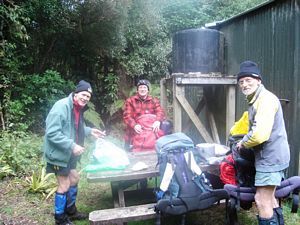
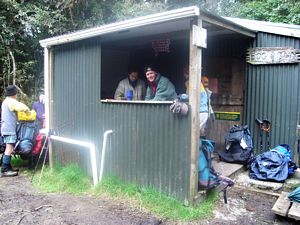
Bog Inn is a small bush hut
built from totara cut nearby. It has four bunks, mattresses, table, seats and a coal range. It is situated
at the edge of a large open mire.
|
|
|
|
|
|
|
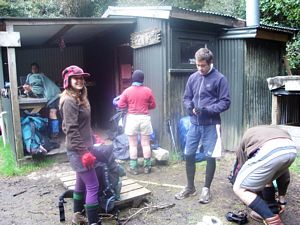
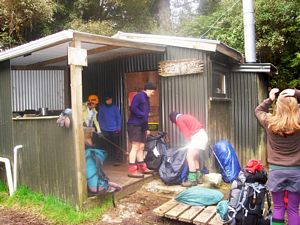
It required an efficient operation to pitch tents and flys, and cook dinner, before dark. Fortunately,
although the ground immediately around the hut was muddy and uneven, there were good sites in the nearby
bush. The hut had a large covered verandah with benches for cooking and washing dishes. The verandah
could sleep several at a push.
After dinner, Phillip led a reflection. “Pureora” means “a sacred
rite performed for the recovery of the sick”, so the focus was on physical healing through prayer, anointing,
and laying on of hands.
Tiredness after an arduous walk caused most to retire early. Five slept
in the hut and the remainder outside. It was a warm and fairly dry night.
Sunday
Weather:
Low cloud, drizzle and rain, strong winds at summit. From Bog Inn we headed north across a broad forested
plateau before climbing gradually up the southern slopes of Mt. Pureora (1165m, 2.5 hours). The open,
scrubby summit provides superb views on a fine day, but unfortunately our visit coincided with cloud,
wind and rain, so no panoramic views were enjoyed. Indeed our pause at the summit was short-lived because
of the adverse conditions. This was a pity, as the views are normally the highlight of this trip.
We rapidly descended 350m (in elevation) to Link Road on a track which has long sections of stepped boardwalk
(1.5 hours).
Crossing the road, we stopped for lunch before continuing along the Link Track towards
Mount Titiraupenga. Significant ups and downs were encountered. En route, Phillip led a reflection, this
time on inner (mental/emotional/spiritual) healing through prayer, trust, and focussing on God’s unconditional
love.
After somewhat longer than expected, we reached a small concrete monument marking the geographic
centre of the North Island, just off Waimanoa Road. This was our journey’s end (2 hours).
Kelvin
and Peter met us with the vehicles and took us back to Taupo, arriving around 4 pm. After sorting out
gear, the vehicles left at 5pm for the return trip home.
The total duration was 7 hours, of which
walking time was 6 hours.
COST: $40-80
|
|
|