20 walkers turned out for the 10km walk which started at the Horse trek park off Coast Road. The first
day the government had allowed groups of 25 to gather. It was good to have the opportunity to reconnect
with the wider club members.
Introductions were made on a sunny Saturday morning. The first part
of the walk took us to the cell tower with views back towards the south end of Muriwai over the golf
course. We then turned north and down the contour to views of Lake Okaihau stopping for a short time.
Lake Okaihau- Meaning – Feast of the Winds. The name "Okaihau" name meaning "Feast of the winds", which
is relevant to the location of the area on a ridge over 200 m above sea level. Taking the track through
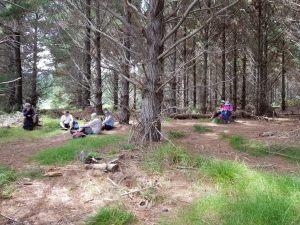
the pine forest was an easy dry meandering track back to the Coast Road. Meeting up with the road, the
group was able to carry on getting acquainted with friends again after the lockdown.
The easy
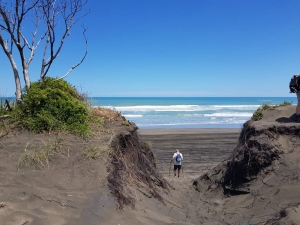
road walk for about 3km led to a right-hand turn following a horse trail to the dunes that form the length
of the playground which is Muriwai beach. Since that Saturday was the first Saturday out of lockdown
for groups we walked amongst sunbathers, surfers, swimmers, dogs running free, lead-footed 4x4 drivers,
bike’s wheel standing and horse trekkers all with a background of waves racing up and over the black
sands which is Muriwai.
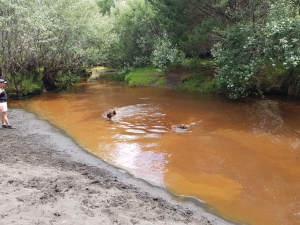
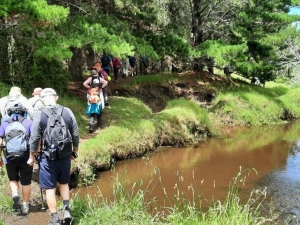
We finished the looped walk following the stream back to the car park.
Here is an explanation for the rusty water looking stream from Geoff Tremain who comes from an engineering
background. He encountered this during my job as an engineer for North Shore City, where the East Coast
Bays streams often have iron staining, especially in summer. It is caused by iron dissolved in the local
groundwaters. Groundwaters are anoxic, and the iron contained in them is in the reduced (Fe2+) form,
which is colourless and soluble. But when it seeps out of the ground and into streams, it is exposed
to the air and is oxidised to its Ferric (Fe3+) form, which is brown and insoluble. It forms a floc
of iron hydroxides, which settles to the bottom, or makes the water brown and turbid. It is most noticeable
in summer when the stream flows are reduced, and the iron is not so diluted. Iron bacteria also feed
on the iron deposits, often forming a nasty looking orange-brown ochre slime (see picture). However,
it is completely natural and non-toxic, although stream bed animals and fish do not coexist with it very
well if there is too much of it. The same thing sometimes happens with water from bores if the ground
is rich in iron. Once the water meets the air, the brown floc forms, which causes staining and sometimes
blockage of pipes. At Woodhill, the whole area is covered with dunes made of iron sand, so this is where
the iron will be coming from in this case.
A great day to be refreshed out of lockdown with great
company of people.
|
|
|
|
|