Although five hardy souls had booked for this winter camping tramp only four went because one poor soul
had severely pulled muscles and tendons in her calf. A wise decision considering we were climbing from
sea level to the highest point in the Hunuas before descending the very steep tracks.
Weather
forecasts were avidly and repeatedly watched during the week beforehand and we decided to continue because
Friday was only light rain, Saturday rain only later in the day and Sunday would dawn sunny and continue
to be a dry day. A dryish day was needed beforehand because water had to be taken up to the campsite
at Adams Lookout, which we did on Friday. The campsite was in a very sad state because of the very wet
conditions so we planned to make camp at the lookout itself. Here we would be able to erect a good shelter
under the lookout and tie windbreaks around to make a good cooking place. Also with the wind changing
to be westerly there would be some shelter provided by the natural slope and bushes.
In the event
the Bracken departure on Saturday was 7.15am and we all met at Waharau around 8.30am. Equipment and food
packages were shared out and packed and we also had a warm drink and snack before starting out around
9.15am. The plan was to use one club Trios tent and one small private tent, two medium billies and two
stoves. In the end we only took one MSR stove and fuel bottle to save weight. It was more than adequate.
Our route followed the red track markers on the northern Waharau Ridge Loop track to the easterly
junction of the Kohukohunui and Mangatangi Ridge tracks at 380m. We turned onto the Mangatangi Ridge
track and descended 80m to cross a tributary of the Mangatangi stream. A nice easy stream bed although
too deep to keep dry feet in boots. We were prepared so did manage to keep our boots dry, rather too
many sandflies though - surprising at this time of year. Then followed the steep, slippery muddy climb
up the Mangatangi ridge to reach the Kohukohunui Trig track at 655m. Turning north -west along this
track we soon (0.5km.) came to the trig at Kohukohunui No.2, the highest point in the ranges at 688m.
It had been steadily raining, as expected, during our climb and although we were sheltered in the bush
we were not looking forward to the remaining hour and a half undulating along the ridges to Adams Lookout
where our water supply awaited. We were therefore surprised and very very pleased when descending from
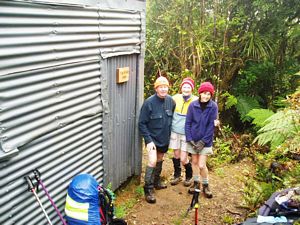
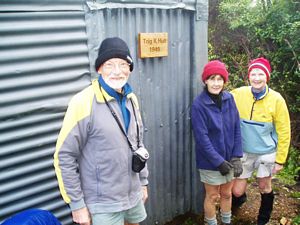
the trig to almost immediately come to a recently maintained hut, not marked on the map, and derelict
when we had last seen it. The door was not locked, there were two bunks inside, it had a water tank,
it was clean and most of all it provided dry shelter. So although it was only 2.15pm we decided to take
advantage of the shelter, stayed for the night and were very grateful. (about 7.5km)
|
|
|
|
As promised, Sunday dawned dry and remained fine, so having had a good bowl of porridge and cleaned up
we set off at 8.30am. along the ridge to Adams Lookout. What a difference dry weather and sunshine make
and how splendid and enjoyable all the many views we had on each of the minor summits we traversed. We
were so grateful that we had stayed in the hut because none of these views would have been had on Saturday
afternoon.
On arrival at Adams Lookout we set about finding our cache of water, trowel and tarpaulins
and prepared for the relatively easy walk back to Waharau. On the way we passed by the campsite we had
actually booked in to and all agreed that it was well missed this time. Some twenty minutes later we
were back where we had left the red track markers on Saturday. This time we continued south and later
east to follow the rest of the Waharau Ridge Track Loop back to the car park at 1.15pm. (about 14km)
We had kept our lunch until now so that we could sit on the beach and enjoy the views across the Firth
of Thames over to the Coromandel Ranges. A perfect ending to a challenging tramp which had worked out
far better than we could have expected.
COST: $10, including $5 for the campsite, because we
were able to utilise much left-over food from two previous tramps.
|
|
|