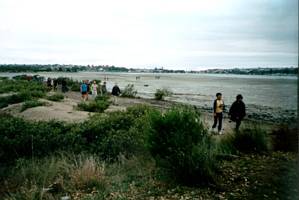
Twenty-eight people turned up on a grey afternoon to have a look at the Tahuna Torea Nature Reserve in
Glendowie and learn a little about the place from retired science teacher Colin Percy, who is involved
in the Tahuna Torea Nature Reserve Preservation Society. On 9 August 1998, Colin led a Club trip through
there and those who went enjoyed learning about the reserve and its birdlife, and he proved to be even
more informative this time almost four years later.
We started from the carpark at the end of
West Tamaki Road about 2pm. The old childhood saying from many a parent is work first, then play, and
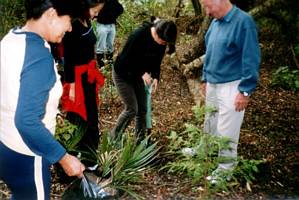
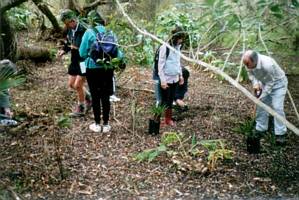
this was the order of the day. It was a pleasure and privilege to be able to help Colin plant several
nikau trees in a swampy (but not boggy) area near the bush walk along the west (inland) side of the reserve.
In time, these trees will grow into a handsome grove.
|
|
|
|
Once the trees were planted, we continued along the track, along a newly constructed board less than
a week old. Colin brightly said that the boardwalk was built specially for us! He told us that 70 years
ago, in the 1930s, the whole area was dairy farm land providing Auckland’s town milk supply. In subsequent
years the farm was abandoned and the land became overgrown in weeds, bracken and gorse. In the 1960s
the place became a reserve, and tracks were cut through the vegetation. Trees were planted, and these
would grow and make perpetual shade, in which many of these unwanted plants could not survive. The biggest
problem however is the willow tree - these would self-sow and proliferate and eventually smother the
place if not dealt with. The willows would be killed by injecting poison into the trunk before the workmen
would climb them to cut them down piece by piece, thereby protecting other native vegetation and wildlife.
Killing the trees this way would ensure the branches remained hard for the work gangs; ringbarking the
trees instead would make the branches soft and not support the men.
|
|
 |
Colin took us to a lookout from where we were able to see the reserve and the Glendowie Sandspit,
with the Tamaki River and Bucklands Beach beyond. He told us that the reserve was named after the fact
that oystercatcher birds would gather there feeding on intertidal organisms - Tahuna Torea means the
gathering-place of the oystercatcher. These are not the only birds that come there - there are many others,
including godwits. Each year in September, at the end of the northern summer, these birds would fly from
Alaska and Siberia to New Zealand, a 3-4 day nonstop journey without any feeding or sleeping breaks,
and remain over our summer until about Easter when they would return to their northern countries. The
birds would wait till a storm was about to arrive before starting their journey - the wind patterns would
aid their lift into the upper atmosphere and its strong wind currents. Godwits generally live about thirty
years, or about 60 of these journeys!
He also explained another Maori place-name for the area
- Waiotaki. Taki was one of the captains of the Tainui canoe, which would have gone up the Tamaki River.
The boat would then be carried overland to the Manukau Harbour before continuing the journey southwards
to Raglan and Kawhia.
|
|
 |
We then went down to the beach on the northern side of the reserve. Colin picked up a piece of clayey
material from the foreshore, and explained that it had come from the great eruption of Taupo. In about
186AD Taupo erupted in what was probably the greatest volcanic eruption in recorded history - its ash
spread around the entire world, having been found in Arctic ice, and blocking the sun for about one week.
The eruption took place probably about March as given by evidence of plant life.
He explained
that more trees will be planted about June further along the sandspit, to replace a number of trees that
had been blown away some years ago in a cyclone.
Colin had to leave us at this point to go to
a Mothers Day family celebration. Because of the we left our introductions and prayer till this point
to give him the maximum amount of time with us.
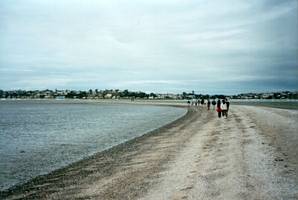
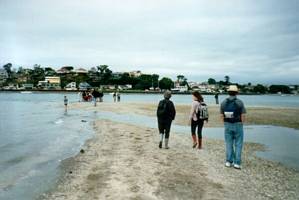
We continued along the beach and right out as
far as we could go along the sandspit - we were now much closer to Bucklands Beach than to mainland Glendowie.
But there was the main channel of Tamaki River in the way, and we saw many yachts and other boats go
by.
|
|
|
|
 |
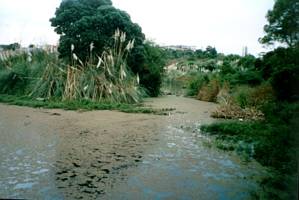
Our walk back to the carpark was along the southern side of the reserve, along the foreshore, then
along a short track through the bush and alongside a waterfowl pond.
|
|
|
|
It was just after 4pm when we finished our walk. A friend had given Lin a pohutukawa variant to plant
in the reserve, and Colin had allowed us to plant this tree in the grassy area between the foreshore
and the waterfowl pond.
|
|
 |
Lin, herself a mother, had also brought along some flower cuttings from home to give to all the other
mums on the tramp to remember the special day.
|
|
 |
|
|
|