|
 |
A total of 27 people took part in a training day focussed on first aid and safety when tramping. The
venue was the PinePac timber yard in Kumeu, and a team of instructors drawn from the Club membership
gave an informative and practical time of training.
We met at 9am and split up into two groups.
One group spent the morning on first aid with Gary, whilst the other group did rope work and safety on
the track with Stuart, Geoff and Paul. After lunch the groups would swap over, so that everyone would
cover all the course work.
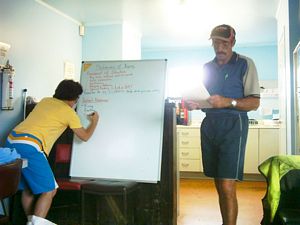
The first aid training focussed on how to deal with an emergency on
the track, when someone in the party has an accident and is seriously injured. Gary, with the help of
Carole on the whiteboard in the smoko room, told us about the importance of assessing the situation of
the injured person, including existing medical problems, heat exhaustion, hypothermia, allergies, asthma,
sprains and fractures, and check the Airway, Breathing and Circulation, before getting help. It is vital
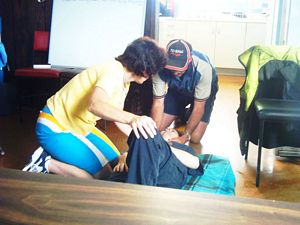
to talk to the patient, asking questions and reassuring him. If necessary, the casualty should be rolled
over carefully into the recovery positon (lying on the side) until help arrives. This can be summed up
as WRAPT - Warmth, Reassurance, Assess again, Positioning, Treatment.
|
|
|
|
|

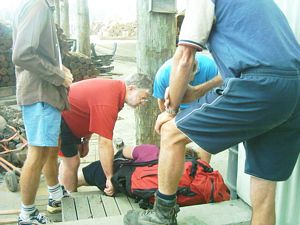
As our “classroom” time drew to a close someone rushed in and said there was a lady who had a bad
fall and was seriously hurt, and we had two minutes to get out there and deal with it. So we rushed out,
and sure enough, Margaret was lying at the bottom of the steps with her large pack still on her back,
badly injured and needing help. We had to ask her what was wrong and how she felt, and had to assess
her situation - how she got her injuries, and make her comfortable while waiting for help.
|
|
|
|
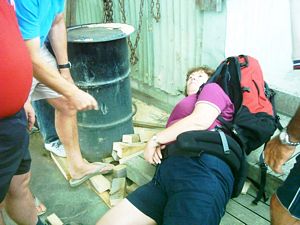
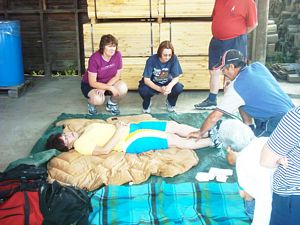
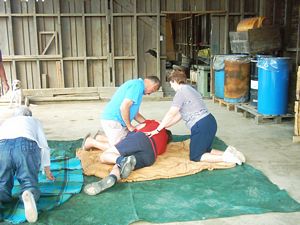
Margaret got up and went with the rest of us to a nearby shed to practise rolling an injured tramper
into the recovery position, or emergency roll, to allow unobstructed breathing and maximum comfort until
help arrives.
|
|
 |
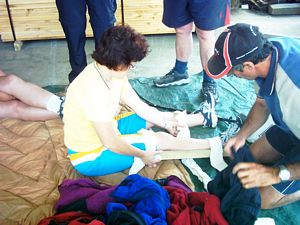
We were also shown how to bandage up various injuries, and apply splints to broken bones, including
the femur (thigh bone), as well as be told about bleeding. A person can safely lose 750ml-1L of blood,
but bleeding needs to be dealt with urgently to prevent further loss and save the patient’s life. The
bright red blood from an artery comes out in squirts and is slippery to control; the dark red blood from
a vein is easier to control. The most common minor bleeding comes from capillaries, and is slow and oozing.
|
|
|
|
|
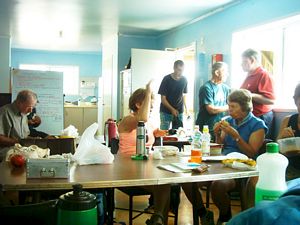
We had our lunch in the smoko room before swapping courses for the afternoon.
|
|
 |
Stuart gave a talk about travel across snow and ice. Travel across snow and ice requires a competent
experienced leader plus ice axes and sunglasses for everyone, warm clothing and a rope for the party.
Hazards in ice and snow travel include slipping on steep ground, hypothermia, snow blindness and sunburn.
The general rule is - keep off unless you know what you are doing.
We then moved to rope work.
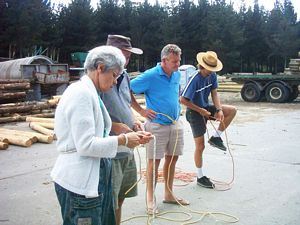
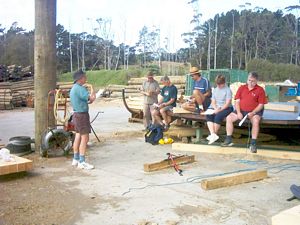
Stuart showed us how to tie two important knots (how many of the group learned these knots in scouts
and guides as children and have since forgotten them??) - the bowline and figure-of-eight, before we
had a practice at belaying a person down a cliff or steep slope to help an injured tramper. The rope
is tied around a firm object such as a tree using a bowline knot, then one person stands close to the
object inside a loop on the rope made with the figure-of-eight knot. This person controls the rope attached
by a bowline knot to the belayer, who is thus let down the cliff face in safety to attend the patient,
and is pulled back up the cliff afterwards. Belaying in this manner also assists groups safely up and
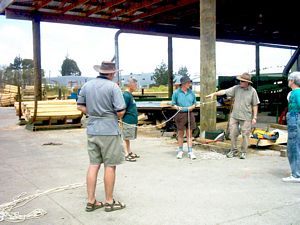
down steep rough slopes, and across steep sidelings and slips. The practice was on level ground; the
person at the end of the rope had to imagine being on a cliff and pull the rope accordingly.
|
|
|
|
|
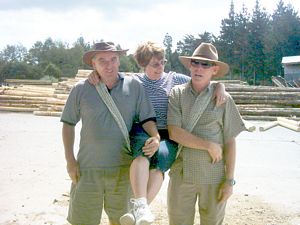
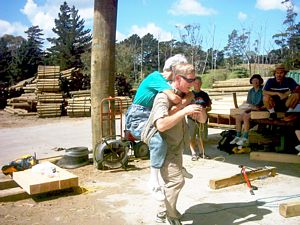
We were also shown how to roll up a rope after use, and how to use a rolled-up rope as a “chair”
for two people to carry an injured person, and a sling for a single person to piggyback his injured companion
on a two-person tramp.
|
|
|
|
|
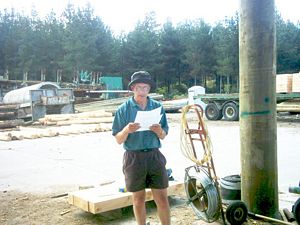
Geoff handed out copies of Safety in the Mountains (the FMC pocket-sized field guide) and pamphlets
on hypothermia and survival before talking about what to do when one or more people in the group go missing
on a tramp. The main party should stop and make much noise, while remining calm. Two of the group should
make a brief search back along the track. After allowing some time to elapse, two people should be sent
to report to police or park rangers; the remainder shoud stay put and camp.
Paul gave a talk on
looking at weather forecasts and signs of worsening weather, and how to deal with an emergency on a tramping
trip. It is most important to check weather forecasts before a tramp, and carry a radio to check forecasts
during the trip, as bad weather can hasten hypothermia, dangerous river crossings, being blown over edges,
etc. Looking at clouds can also predict weather, eg. humpback clouds usually precede rain or storm conditions.
Local weather characteristics also need to be considered. If the weather packs up unexpectedly, it is
best to can the trip or stay put until it improves.
Each emergency on a tramping trip is different.
One must assess what has happened, the risks of the situation, and what action to take. The group must
discuss the situation and formulate a clear plan that each person needs to understand and follow. After
committing it to God in prayer, the group needs to carry out the plan until it is finished. Avoidance
is best, of course - planning, procedures and disciplines of the group must be such that foreseeable
emergencies are avoided. Unfortunately, the unforseeable can happen. After an emergency, we need to ask
ourselves (1) can this be avoided in futhre? (2) could the emergency be handled in a better way? Did
we make mistakes? We need to be humble and learn to do things better.
|
|
|
|
|
The one-day course was finished by 4pm, and we headed off home clued up a bit on how to deal with
unwanted and unexpected situations that can happen on any type of tramping trip anywhere, be it club,
private or otherwise; and also how to avoid these occurrences in the first place.
COST: Free (carpooling
from The Bracken $4).
|
|
|