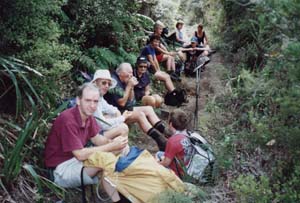
Two options were offered for this trip to the Pureora Forest in the King Country - an easy option for
those who were after a more relaxing weekend looking at some of the lovely walks in the area, and a hard
option for those who wanted to practise pack-carrying.
Friday
We left The Bracken right
on 6:15pm in a van hired from Unitec and two cars, and after a dinner stop for us at Ngaruawahia and
a dinner stop for the van at the BP at the start of SH30 in Te Kuiti, we travelled in convoy through
Benneydale to the Pureora Village. It was a moonlit night which made for pleasant travelling into the
King Country.
Our overnighting was at the DOC cabins behind the DOC Field Centre at Pureora.
The hard group would move on next day, while the easy group would be spending all three nights of the
long weekend there. We hired four 6-to-8-bed cabins for the first night and three for the other nights.
Each cabin had bunks, a kitchen and dining area, but we had our meals in cabin 7, the ladies’ cabin.
|
|
 |
Saturday
The hard group were up at the crack of dawn and were away by 8am, with David
K taking them in the Unitec van to the start of the Hauhungaroa Track at the derelict Nuffield Lodge
east of Ongarue.
From the Nuffield Lodge the track went through the old Mangakahu mill workings
before a good two-and-a-half hour grunt to Motere Trig (989m asl), our lunch stop. It was more of a route
than a track, being largely unformed, and we had to rely on the white markers - this had been done deliberately
to protect the ecology of the Hauhungaroa Range.
We continued along the flat to gently undulating
crest of the Hauhungaroa Range for another two-and-a-half hours before swinging northeast to descend
the long spur into the Te Awaiti Stream. A broad flat campsite beneath two towering totara trees about
90 minutes down the spur made a comfortable overnight stop. It turned out that that was the last substantial
supply of water for camping.
The easy group had breakfast in Cabin 7 about 8am. We then drove
to the Waipapa Walk, about 15min drive from the cabins. This was off the road to the north block of Pureora
Forest - once on the side road a locked gate across the road meant we had to road-bash about 15min to
the outdoor education centre at the start of the track.
We had a bit of trouble trying to find
the Waipapa Walk. A signpost behind the education centre only had letters and numbers, and we could not
find any other signposted track. John came up with the idea of peeping through the window of the education
centre with binoculars to study a map of the track that happened to be on the wall of the common room
inside, and we concluded that the signpost was in fact the track we were after.
The Waipapa Walk
was a one hour loop walk through an area of the forest set apart as the Waipapa Ecological Area, set
up as a nature walk by the outdoor education centre. We set out through grass at first then into what
the map in the common room described as a “forest tunnel”, a stretch of dense bush. Soon we came to a
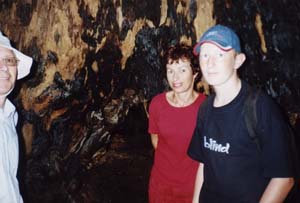
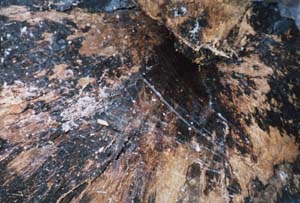
side track leading to a large totara tree, which must have been the highlight of the walk. Not that it
was a totara tree, but that the bottom of the trunk was hollow and we were able to climb inside it! One
of us likened it to the movie Lord of the Rings, on at the picture theatres at the time.
|
|
 |
|
|
The track carried on to a lookout over a bushclad valley - Chris, a teenager, suggested having a
flying fox across the valley! There was another lookout a little further on. 9yo Jonathan and his dad
David H said they found a little butterfly in the undergrowth. We thought they were having us on, as
it looked like two dead leaves resembling a pair of wings. But it was not till one of us poked these
“leaves” with a twig and saw the creature fly off that we realised it was genuine.
|
|
 |
We passed a pond before the track came out on the access road to the outdoor education centre. Then
it was back into the cars and to the cabins for our lunch - as with the first day of all Club weekend
trips, we ate our own lunches we brought with us.
|
|
 |
By now David K was back with the Unitec van, and after lunch we set out along Link Rd to the Link
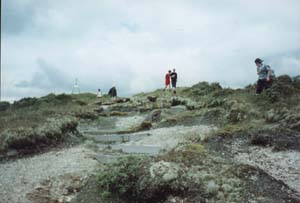
Track access to the summit of Mt Pureora. This was an easy one-and-a-half hour climb on a well-formed
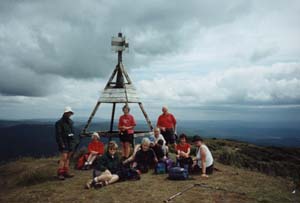
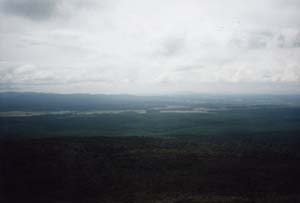
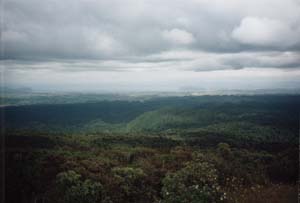
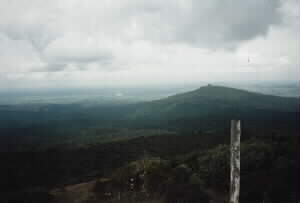
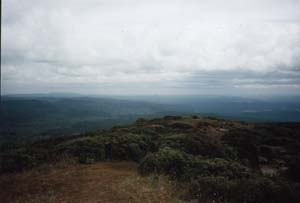
track through bush on the north side of the mountain. The summit was just above the bushline in subalpine
scrub and meadow, and commanded a panoramic view all around. To the south Lake Taupo - unfortunately
the National Park mountains were in cloud. To the west was the bush terrain of the central King Country,
with the distinctive tabletop pimple of Hikurangi near Taumarunui. Looking northwards we saw the Rangitoto
Range and the Mangakino Valley, with Lake Maraetai on the Waikato River clearly visible. The eastern
segment included the hills of the Kinleith Forest, and in the distance the outline of Mt Tarawera was
clearly recognised through binoculars - it was too hazy to see either Mt Te Aroha or Mt Egmont.
|
|
|
|
|
|
|
|
We went down the Toi Toi Track on the west side of the mountain, while David K returned the same
way to bring the van around. The Toi Toi Track was similar to the way we came up, and finished with a
stand of Douglas fir trees planted in 1962.
Unfortunately the roads in the forest were
not well signposted, and David was hunting and hunting for the correct, eventually having to go back
to Pureora to ask how to find the Toi Toi Road. He eventually found the right road, and saw us walking
down the road, so we got into the van and drove back to the cabins for dinner.
|
|
 |
At 7:30pm for those who wanted to, we did the 30-minute Totara Track, a well-formed wheelchair-suitable
walk through some of Pureora’s lovely native bush just 5min walk from the cabins.
Sunday
For the easy group, this was to be a hike in from the western Taupo Road to the Waihaha Hut along the
Waihaha Track. The hard group was to tramp to this hut for the night, and we were hoping to meet up with
the group even if for a brief time.
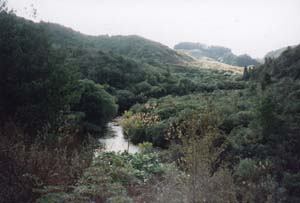
We set out about 9am following a well-defined benched track
for the whole three-hour journey to the hut. It started on the northern side of the Waihaha River, then
crossed a tributary of the river over a swing bridge before climbing up to follow a high ridge. There
were one or two lookout points on the way.
|
|
|
|
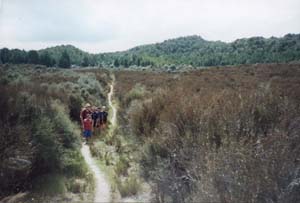
Later the track dropped gradually to cross a large grass clearing with clumps of bush, and eventually
once more follow the north bank of the Waihaha River.
|
|
|
|
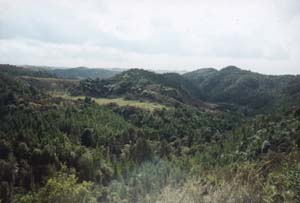
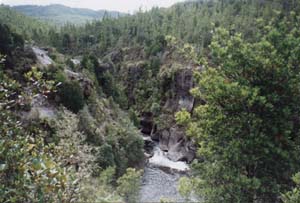
We climbed gradually once more, and came out to a lookout where, down below, we could see the river
enter a narrow rocky gorge.
|
|
|
|
 |
As we carried on, we passed three hunters, one carrying the carcass of a deer they had just shot.
A little later the track entered lovely podocarp forest, and after about half an hour the Waihaha Hut
appeared, all of a sudden!
|
|
 |
At the hut were a few hunters and trampers, but no sign of the hard group. Some of us tested a swimming
hole in the river behind the hut, but it was freezing!
|
|
 |
We had lunch outside the hut, then set out at 1:30pm for the walk back to the Taupo road. We were
not to know till next day that the hard group made good time on the Hauhungaroa route, dropping off the
mountain range after two more hours tramping from the campsite, with a further two hours of following
the true left bank of the Waihaha Stream to the hut incorporating a lunch stop amid towering trees and
voracious ants.
For the easy group it was a pleasant walk returning on the Waihaha Track.
We stopped once more at the lookout where the river entered the rocky gorge, but that proved to be a
bit hot with no shelter from the sun. So we went on for a few minutes and stopped right in the bush.
We pondered the power and beauty of God’s creation as we sang the first two verses of How Great Thou
Art, then David K shared a thought from chapter 32 of a book How to Live in High Victory. The author,
Harold Hill, had done a little study on the Bible verse from Isaiah They that wait on the Lord shall
renew their strength, they shall mount up as eagles.... and looked up an encyclopedia about the eagle.
Every seven years an eagle would retreat alone to an isolated place in the mountains, then use its beak
to strip itself of every single feather before pulling out all its claws. Then it would grind its beak
against the rocks right down to the base before waiting for several weeks while new feathers, claws and
a new beak would develop - a time of renewal for the bird. David then said that a weekend such as this
would make a time of renewal for us as we withdraw away from our daily routines and civilisation to be
amongst God’s natural creation.
|
|
As we walked over the high ridge further down the track, locusts were flying around and often we
would be hit by them as they swarmed. When we arrived at the swing bridge, we had a most refreshing swim
in the river.
|
|
 |
Chris was the first one out - he ran the last stretch - and was greeted at the carpark by someone
who wanted to report that all the cars at the Waihaha Scenic Reserve carpark nearby, including his one,
had been broken into and immobilised overnight. John was next out, and was unable to use his cellphone
as it was out of range. The rest of the group came out straight after, and Chris and 9yo Jonathan were
asked to ride the “boot” area at the very back of the van to give room for the break-in victim and one
of his mates for the short ride to the Tihoi Trader shop (an ice-cream shop and small pub) where they
could use the telephone to contact police and friends in Taumarunui.
We carried on to Mangakino
as the van’s tummy was rumbling. The two petrol stations near the Whakamaru turnoff had closed for the
day, and we were lucky to find someone to open up the station at Mangakino to tank up the van - the station
was rewarded in turn by another vehicle pulling up for dinner. From there is was back to the cabins for
our dinner.
Monday
Another glorious morning. The easy group had to be out of the cabins
by 10am, and once breakfast, packing and cleaning up were done, we were on our way.
Our first
stop was the track to the observation tower at the end of Bismarck Rd, ten ninutes drive from the cabins.
From the road end, a five minute walk along a wide track brought us to a 12metre wooden tower deep in
the forest. This had been built by DOC to give people the opportunity to view the top, or canopy, of
the bush, as bush tracks go along the bottom and not the top of the bush.
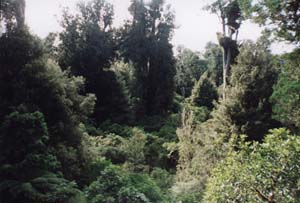
The view from the top
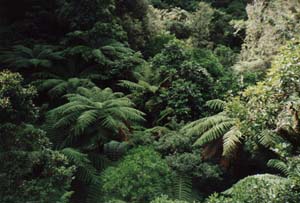
was unique - above the canopy rose the very tall trees (rimu, matai, kahikatea), standing out alone or
in groups above a sea of tree-tops including numerous ponga fern trees. The forest was resounding to
the summertime music of the cicadas, and several of the insects were perched on the side of the tower
near the top.
|
|
|
|
We then carried on to the Kakaho campground further along Link Road, which was to be the lunch spot
for both groups before the journey home.
While David K took the Unitec van around to the western
Taupo road to pick the hard group up from the Waihaha Track, we tried out the Rimu Walk behind the campground.
This benched track went past a swimming hole and over a bridge before climbing to a lookout where we
were able to see Mt Pureora.
|
|
|
|
We continued along the track, dropping down to the campground, and as we emerged, to our surprise
we saw the others from the hard group. They had left the Waihaha Hut right on 8am for the three hour
trek out to the Taupo Road, and came out just as David arrived in the van at 11am.
|
|
 |
Both groups had lunch together, sharing experiences over sandwiches and cakes, and by 12:30pm were
packed and homeward bound. Although we could have travelled home via Mangakino and Te Awamutu, the general
rule of use State Highway 27 where practical applied in this case. We travelled through the Kinleith
Forest to Tokoroa, and had an icecream stop at Matamata - one of the group had unwittingly “given” his
pocket-size stereo headphone radio to whoever would find it, possibly a street kid to listen to the raucous
heavy-metal “music” that most of our group hated!
|
|
 |
We were all back at The Bracken soon after 4pm, having had a lovely “time of renewal” amongst God’s
lovely native bush.
COST: $95 (travel $50; food $20; accommodation $25)
|
|
|
|
|
|
|
|
|
|
|
|