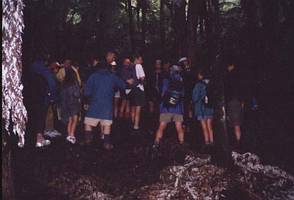
This was a Sunday afternoon trip with a difference - instead of exploring a part of the Auckland area
we explored the world of the fungus with noted mycologist Dr Peter Buchanan, who works for Landcare Research.
Peter had taken us out almost exactly five years ago, on Sunday 20 April 1997, to the start of the Twin
Peaks Track near Huia and those who went had a very informative time.
The start of the Goldie’s
Bush Walkway inland from Bethells/Muriwai was where Peter took us this time. Only 4 people met at The
Bracken; the remaining 21 assembled outside the Waitakere School at 2pm, and from there we drove to the
end of Horsemans Rd where the walkway begins.
Peter gave an introductory talk about fungi, and
what they are. He started by saying there were three categories or functions of fungi (a) those that
cause disease and rot - most plant diseases are caused by fungi, (b) decay and decomposition of leaves,
logs, etc are almost entirely done by fungi (insects found in rotting logs are actually feeding on the
fungi), and (c) those that help plants grow - almost all plants have fungi in their roots. The fungi
and plants develop together and provide food for each other. There are believed to be about 40,000 different
types of fungi in New Zealand, with only about 6000 species recorded.
What one sees as a fungus
(ie. mushrooms, toadstools, bracket-fungi, etc) is just the fruitbody or reproductive portion, just like
a flower on a plant. The rest of the fungus is much larger and is a maze of very slender threads going
through the soil or other substrate. He would never use the word toadstool to describe a non-edible mushroom;
only a small proportion of mushrooms are poisonous including the deadly death-cup which produces a severe
illness to start with, with signs of a good recovery soon after but then a sudden death of the victim
after about five days.
To collect fungi one needs a hand-lens, a pair of secateurs, a fold-up
saw, a knife (to cut out the base of the fungus in the soil), paper bags (fungi sweat in plastic bags
causing them to deteriorate), insect repellent, and pocket-size reference books.
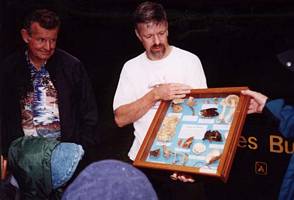
Peter showed
us a display case with the various types of fungus, and passed around some reference books and leaflets
describing the recent NZ Post stamp issue featuring NZ fungi, the first set of stamps featuring fungi
issued in New Zealand.
|
|
 |
We walked about 100 metres along the track, to just past the fork junction, and started ravaging
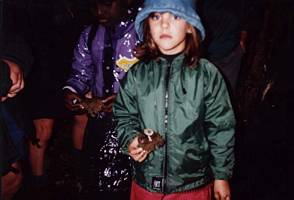
the undergrowth for fungi. Several young children were in the group, and they were very keen to get their
treasures - Peter commented that young children with their eyes closer to the ground than grown-ups more
readily spotted the fungi.
|
|
|
|
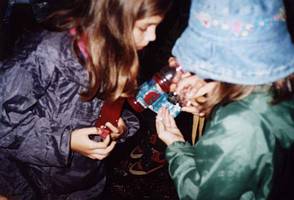
The treasures collected included several small cup fungi, some very tiny mushrooms, a wasp that had
been killed and “taken over” by a fungus, a cicada that suffered the same fate, and some fungi that looked
like light-coloured spots or patches on rotting wood.
|
|
 |
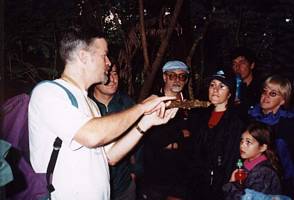
Peter told more interesting tales and facts, including a house whose tenant went away for four weeks.
When he returned, because the wood of the old house was in poor condition, he was shocked to see fungi
growing everywhere, even through the carpets as well! Another house had to have its entire ground floor
replaced. If a beech forest is exterminated, that also exterminates several hundred types of fungi.
|
|
 |
He also told us about mushroom farms, which use a special type of compost which is treated to remove
other fungi and allow the farmed mushrooms to thrive and grow. The closest farm to Auckland is near Mercer
where the engineering-minded farmers have developed a special process. The best farm for the public to
see in near Carterton in the Wairarapa, but there is also a farm near Morrinsville that has public tours.
Nelson presented Peter with a box of chocolates, and we all showed our approval with a good hand-clap.
It was almost 5pm as we walked back to the car park. Just a 200 metre return tramp overall, but very
well worth it for an insight into one little aspect of God’s creation.
COST: $4 for the single
carload from The Bracken
|
|
|