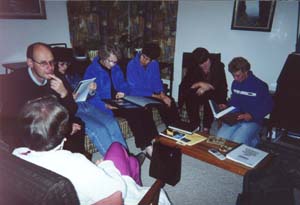
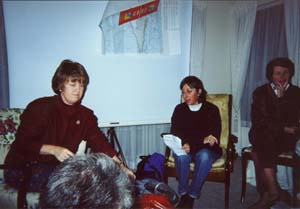
A large crowd gathered at Paul’s home in Meadowbank for a very interesting and informative Club Night
|
|
|
|
The two Phillips started by giving us ideas on how to pack for a harder pack-carrying tramp. Phillip
N showed us a few things that could make the pack lighter to carry. A towel made of synthetic material
and available from sports shops for $10-$35 is light and small and does thesame as a normal towel, and
will last a long time if it is squeezed rather than wrung when washed. Three sheets of Super Cloth, bought
from a $2 shop, would also do. Two small penlite-style torches are much lighter than a large torch -
it is always a good idea to take two of these, one being a spare in case the bulb goes dead, and to check
the batteries first and take spare batteries for both these torches. A CD makes an excellent flashing
mirror over a long distance if the party gets lost or otherwise and has to be rescued. A tiny piece of
soap is all that is required for personal hygiene instead of a large cake of soap.
Phillip D handed
out a sheet he had prepared about selecting a tramping pack. The most desirable pack would be 60-80 litres,
weigh 1.0-2.5kg empty, made of robust waterproof material such as 1000 denier Cordura canvas (not high
density nylon), loading through top and bottom (a separate zipped bottom loading area is handy), handy
front, top and side pockets, an internal “security” pocket under the top flap, have a padded adjustable
harness and waist band, and a light waterproof cloth extension with drawstring for closing the top of
the pack. Internal frame packs are invaluable in difficult terrain as they areless likely to snag on
branches etc, while external frame packs are more comfortable and cooler to wear and require less careful
packing making them very popular for extended trips. A suitcase-style travel pack if chosen should have
up to 80 litres capacity, a large zipped opening panel, a separate bottom loading compartment, internal
retaining straps, two padded carrying handles, a hide-away harness system and a zip-on zip-off daypack.
The best way to pack a backpack depends on the individual person, but the heaviest part of the load
should be closest to the person’s back and shoulderblades. Some women may find that heavier items should
be put in the bottom of the back because a woman’s centre of gravity tends to be lower than a man’s.
Gear must be kept dry - use loose-fitting plastic bags or a packliner.
Two trained nurses, Ruth
and Myra then put on a presentation about hypothermia (exposure sickness) and how to prevent it. Ruth
explained that hypothermia is a dangerous lowering of the body temperature that affects the internal
organs. When the body temperature drops from thenormal 37º to 25º exhaustion and unconsciousness sets
in, and when it goes below 20º the person will die. The main contributing factors for hypothermia are
wet and cold, with wetness being the major problem. Wet clothes conduct heat away from the body, which
then has to work harder to keep warm. When crossing rivers it is a good idea to strip to underwear, taking
that off afterwards and putting on dry clothes. It is important to keep your own clothes dry, and not
to depend on others in the party for dry clothes. If a party has to stop in the cold, a hot drink makes
all the difference in warming the body up - a small lightweight solid-fuel burner was passed around.
Eating fatty foods also produce more heat that other types of food. When someone gets hypothermia, stop
right away - it can take only 30 minutes from onset to unconsciousness. Never leave the victim alone
when sending someone out to raise the alarm; place the victim in a sleeping bag with another person to
provide the warmth. Recovery from hypothermia takes a long time, typically a couple of days. Marian commented
that she was growled at by a trip leader for bringing a thermos on a tramp!
Myra then spoke of
how to avoid hypothermia. Bring warm clothing even on a hot day; a waterproof coat keeps wind off as
well as rain, and a hot dry day can easily become wet and miserable! A dry jersey should be carried
for an emergency. The biggest area of heat loss is the head, so bring any type of woollen hat. Wear polyprops,
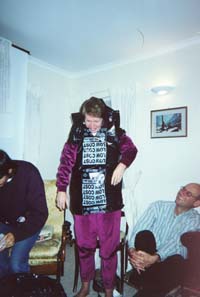
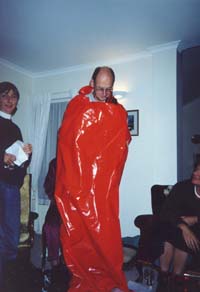
which absorb sweat, close to the skin. Barbara and Egon “modelled” a makeshift coat from a black garden
refuse bag and a makeshift sleeping-bag-type shelter from an orange packliner costing about $10. A lightweight
tinfoil blanket is durable and strong and is made for such emergencies - they are not suitable as an
alternative for sleeping bags etc. in normal use. A thermos is useful for day tramps only, and carry
an extra sandwich in the lunch bag for emergency use - if not used it can be eaten at the end of the
trip or used for bird feeding.
|
|
|
|
Phillip D then took us on an armchair trip to Israel. He had been there twice in the last ten years.
Israel has an area the size of Northland and Auckland combined, and has hardly any scope for overnight
tramping. Most of the tramping is in caves, deserts, rock formations and craters - there are few areas
of forest. Phillip handed out a sheet listing suggested day tramps - these included the world’s largest
crater Maktesh Ramon, Eliat, the Dead Sea, Wadi Qelt and Golan. SPNI shops in Jerusalem and Te Aviv have
good maps but they are mostly in Hebrew. To combat the intense heat, always start early in the morning,
avoid 12noon-3pm, wear a hat and take 3-4 litres water per day. The situation changes daily - always
check with information centres first, and keep to the track lest you stray into a minefield or fighting.
Fortun ately, we did not need to worry about the heat or military activity for our slide trip
through Israel. We went through Jerusalem visiting the Mount of Olives, Hezekiah’s Tunnel at Siloam,
the Old City, the Wailing Wall, Gethsemane (the olive tree Jesus prayed under is either still there or
had a remnant which eventually grew into one of today’s trees), and the site of the Temple which is at
present occupied by a mosque. Devout Jews believe that the mosque will be miraculously replaced by God’s
temple at the time of the return of Christ. We then had a look at other places in Israel including the
Dead Sea, the Jordan River, the Plain of Armageddon (site of many battles over the centuries, and the
site of the world’s final battle resulting in Christ’s millennial reign) and Tel Aviv. Once back at chez
Paul, Phillip handed out some sheets he had prepared on the significance of Israel through history and
into the future and God’s end-time programme culminating in the Second Coming of Christ and His millennial
reign on earth.
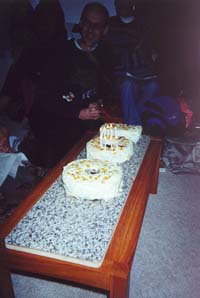
After a lavish potluck supper we all gathered back in the lounge to celebrate
the twin brothers Phillip and Roger, whom God had made almost exactly fifty years ago. The birthday cake
was in the shape of the number 100, ie. twice 50, and Roger blew out five of the ten candles and Phillip
blew out the remaining ones. We then had a time of sharing experiences with the two brothers on tramps
- they had been part of the Club since just about the beginning over twenty years before. Lin started
by reading a passage from the Book of Job, and commented that in hearing what Phillip had shared about
Israel is an illustration of how God gives wisdom to people to share with others. David W, a close friend
of the twins right back to the start, recalled a tramp at Labour weekend 1981 led by Phillip and the
well-known barefoot bushtop protester Stephen King to his stamping ground, the Pureora Forest. Phillip
had asked Stephen to bring his tent and it was pitched near the Waihaha Hut. Then down came the rain!
The groundsheet became wet because the tent leaked profusely, so we all crowded into the hut which was
occupied by a NFAC party. David recalled trying to sleep top-to-tail with Roger on a shelf above the
door of the hut, and drinking heaps of water to avoid dehydration. Two years later, the Club was on its
way to the Nelson Lakes and was travelling there with anAuckland Tramping Club group in their bus (really
a truck set up with mattresses to allow passengers to doss down for the night without having to pitch
tents), and when they reached an overnight stop on the roadside near Mangaweka our Club group got out
of the cramped bus to pitch the tent fly about 1:30am. Two hours later down the rain, and by 5:30am the
beds and air mattresses were literally floating - the tent had been unknowingly put up in the pitch-dark
in a hollow! Nelson told of an occasion where patient Phillip spent hours encouraging a party to cross
one at a time a long three-wire bridge somewhere in Fiordland. Then he related how, on a trip to Leitch’s
Clearing in September 1999, Roger organised an optional impromptu tramp up to a high trig and gave no
time to get ready for it - and when he got to the first high point he just wanted to carry on regardless!
|
|
 |
It was almost midnight when the whole show finished - some, including one lady who had to be up for
work at 7am next day, had already left to go home. Everyone enjoyed themselves and gained extra wisdom
in the area of packing, hypothermia and Israel.
|
|
|