This trip focussed on the north Kaipara area, including a day trip to North Kaipara Head and a climb
up Maungaraho, with the Arapohue Bush Camp as our base. 12 people had a really enjoyable weekend.
Friday
Two car loads left The Bracken at 6:15pm and met up at Wellsford with two car loads from
the North Shore. After a stop there for munchies we carried on to the Arapohue Bush Camp southeast of
Dargaville, arriving about 10pm. Ben and Sarah, who had come across from Whangarei, were waiting for
us - they had arrived just after 8pm. We settled in for the night, the three married couples sleeping
in a house that was once the Dargaville police station, the single ladies sleeping upstairs in the main
building of the camp, and the single men sleeping downstairs in the camp’s common room.
Arapohue
Bush camp had been established in the early 1960s by Graham Crawshaw, who had a vision of presenting
the gospel of Jesus Christ to disadvantaged children at holiday camps. He ran these camps for many years
during school holidays, but in recent years he has changed his focus to running camps for children who
are unable to read. These week-long literacy camps, mainly held during the school term, have produced
changes in many children that have astonished both parents and school teachers.
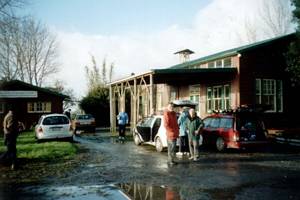
The camp buildings
have a true rustic character - no television, no carpet (except in the old police station), old but still
functional stoves and fridge in the kitchen, the lino on the kitchen floor not completely flat, a large
open fireplace, the chandeliers in the common room made of old wooden cart wheels, and characteristic
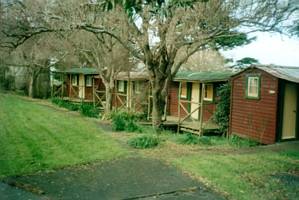
wood frames around the windows. The cabins had a mixed history - the old police station already mentioned,
some old farm huts, several railway wagons, and some purpose-built in the 1960s in the same rustic manner.
There were no playstations or other mod-cons for the kids - just the old pastimes of table tennis, pool
billiards, piano and ball games.
Saturday
We were woken in the middle of the night by
the sound of heavy rain on the roof. But that turned out not to be as ominous as it sounded. The day
dawned with sunshine, although there were still some passing showers. By the time we had the Vice Presidential
Cups Of Tea In Bed Service, rose and had breakfast, and were in our cars by 8am, most of the rain had
gone away.
|
|
|
|
|
|
|
We headed through Dargaville and stopped at Te Kopuru to ensure all three cars were together
before carrying on in convoy towards Pouto, on the north head of the Kaipara Harbour. About ten kilometres
before Pouto we left the main road, turning into Ari Ari Road and the privately owned Pouto Forest. We
had already obtained permission from Rayonier to take the vehicles through the forest as far as the end
of Light House Road.
The three cars were then taken to the finish point of our tramp, the end
of the main road at Pouto, and all the drivers returned to the end of Light House Road in one of the
cars. The rest of us ended up with a wait of one hour, thanks to the condition of the forest roads -
this test of patience was very much relieved with a good read of the NZ Herald.
|
|
 |
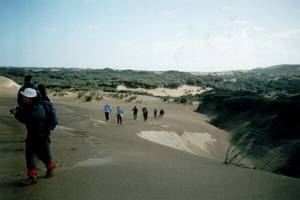
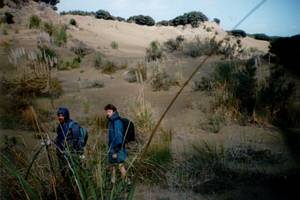
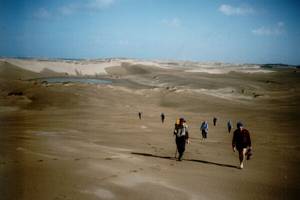
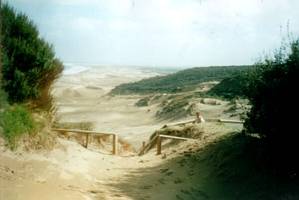
It was 11am by the time we set off on our tramp, following a map-and-compass course over a large
desert of sand dunes with pockets of vegetation.
|
|
|
|
|
We had a lot of fun running down several sand hills.
|
|
 |
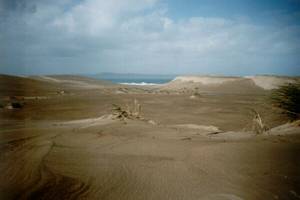
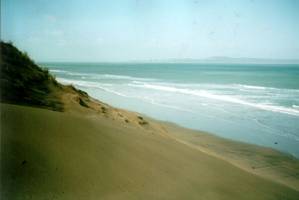
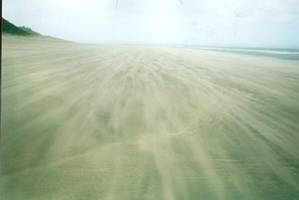
Eventually the sand dunes became completely bare, and we were able to see the Tasman Sea and the
entrance to the Kaipara Harbour, with the white-caps caused by the strong westerly wind.
|
|
|
|
|
Ahead of us we could see the North Kaipara Head lighthouse perched on the top of a hill. We
climbed up to the lighthouse, which had been built in 1884 from solid kauri timber, and is now protected
by the Historic Places Trust. This lighthouse had been in use until 1947 when the Kaipara Harbour was
finally closed to shipping following the opening of a railway line from Auckland to Dargaville. The light
itself was then taken to a lighthouse on the Otago coast.
|
|
 |
Inside the lighthouse a spiral staircase of iron led up two levels to where the large lamp
used to be.
|
|
 |
We could walk out onto the platform that had surrounded the light.
|
|
 |
We could also climb right up into the housing for the lamp and look out the windows that the light
had shone through.
|
|
 |
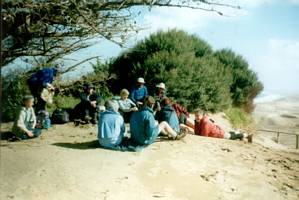
The lighthouse was surrounded by a small patch of bush, and made an excellent spot for lunch out
of the strong wind.
|
|
|
|
Heather shared a few thoughts on what the Bible has to say about lights. The Book of John begins
with In the beginning was the Word, and the Word was with God, and the Word was God. The same was in
the beginning with God. All things were made by him; and without him was not any thing made that was
made. In him was life; and the life was the light of men. And the light shineth in darkness; and the
darkness comprehended it not. John says that Jesus Christ is the creator of light, and that darkness
does not overcome light. When we follow Jesus, the true light, He lights our path. Later in the Book
of John Jesus says I am the light of the world and in John 12:45-46 Jesus said, He that believeth
on me, believeth not on me, but on him that sent me. And he that seeth me seeth him that sent me. I am
come a light into the world, that whosoever believeth on me should not abide in darkness. In Matthew
5 Jesus says that we are the light of the world, which must not be hidden under a bushel but allowed
to shine for everyone to see. This is our challenge - in Ephesians 5:8 Paul writes For ye were sometimes
darkness, but now are ye light in the Lord: walk as children of light.
At 1:45pm we left
the lighthouse and wasted no time in dropping down to the beach below.
|
|
|
|
|
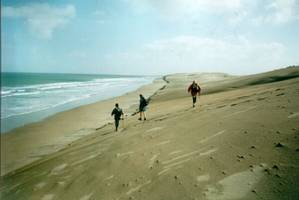
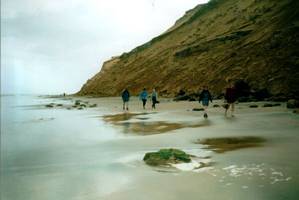
With a strong wind behind us we had a very pleasant one-and-a-half-hour walk along the beach
finishing at the road end at Pouto, arriving just after 3pm.
|
|
|
|
|
We had our mandatory ice cream at the nearby shop, then all 12 of us managed to pile into the two
cars, two sitting behind the back seat of Garry's station wagon. We then retrieved the third car from
the forest and headed into the Dargaville for a break at the Blah Blah Blah cafe.
|
|
 |
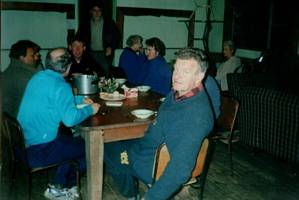
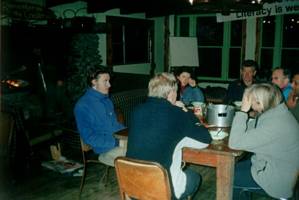
Back at Arapohue bush camp in the evening we had a lovely dinner of lasagne, then just relaxed around
the roaring fire.
|
|
|
|
|
 |
Sunday
Nelson and Paul fought the blanket grab and were away soon after 6am to watch a
replay of an international rugby match from Durban in South Africa at the Dargaville Baptist Church at
7am that resulted in New Zealand winning the game against the host country. The rest of us got up as
soon as it was light, had our Goldilocks breakfast, and were away by 9am headed for Maungaraho, the large
volcanic rock that could be seen from the camp kitchen. When Nelson and Paul had finished watching the
rugby they came back in time to join us.
|
|
 |
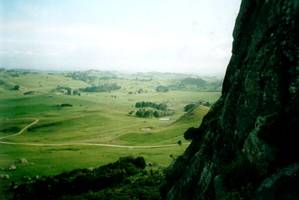
A well formed track appeared to go up the rock, but it soon became rough and petered
out at the foot of a large bare rock face.
|
|
 |
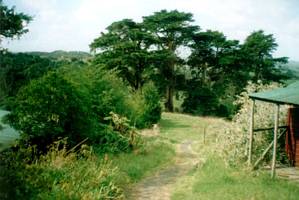
We returned to the bottom and took another track that went into the bush. This sidled around the
base of the rock, climbing gradually. When we reached the south end of the rock we scrambled up to a
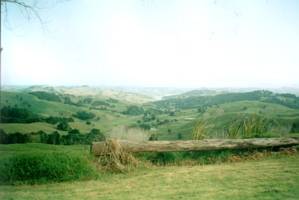
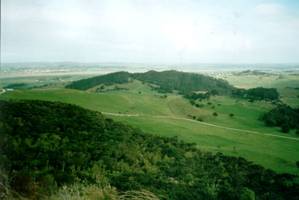
viewpoint where we had an excellent view northwards towards Te Kopuru across the Wairoa River, the rolling
farm country around Arapohue, and the Tangihua Ranges in the distance.
|
|
|
|
|
 |
Looking southwards we could see Maungaraho's brother Tokatoka with its characteristic pointed shape.
|
|
 |
A cold biting wind prevented us from spending much time there, so we returned to the main track which
carried on around the eastern side of the rock, the sheer face of volcanic material rising up to our
left.
|
|
 |
We took a break and listened to Nelson telling us about the areas we like to climb - Tutamoe, Taranaki,
etc. He said that it is a wonderful experience to climb these mountains, and a wonderful thrill to help
other people climb them. Mountains offer both a view and a challenge, and the theme of the devotion was
going to the top for God. Paul described his recent climb up Kilimanjaro, the highest mountain in Africa,
as a mixed experience. On the way up, two days before reaching the summit, he was sure someone in the
group would die in the hostile environment, but when he reached the top he was very lucky to spend one
and a half hours looking down on to the plains below from a place that is normally cold and windy. Paul
had a sense of achievement, the same sense when we achieve things for God. He had the opportunity to
climb another mountain as well and grabbed it. He said that opportunities appear in our lives and we
need to grab them before they disappear. Nelson said that we need to set aside every weight in the Christian
life, and we need
to go to God for guidance - it may possibly be that we need to change direction
or timing, etc. A lot of the things in climbing can be applied to the Christian life. Backsliding in
the Christian life is all too easy - easy to falter, slide, etc. If we do our the best for God He will
give the best for us.
|
|
 |
We carried on and soon found the correct track to the summit. However we came to a difficult
rock face that had a rope strung across it to make it easier to negotiate. Because it was winter and
there had been much rain recently, the rock surface was very slippery and only Nelson, Ben, Sarah and
Stuart accepted the challenge. If this had been in the summer months, the going would have been much
easier and we all would have climbed to the summit of Maungaraho.
|
|
 |
Once over this part these four people found the rest of the climb to the top, up the backbone
of the rock, quite easy going. They were rewarded with a panoramic view all around, and sunshine to enjoy
it with. The rest of the group carried on around the base of the rock to eventually come back to the
car park, where they could see the four on the top of the rock.
We were to have climbed Tokatoka
as well, but because we were running out of time we headed straight back to the camp for lunch. We then
packed up and cleaned up, and were away by 1pm for the 2½-hour drive back to Auckland, having had a fantastic
weekend.
COST: $72 (travel $34-50; food $17-50; accommodation $20) .
|
|
|